Costa Rica has become one of the most sought-after real estate markets in the Western Hemisphere — and for good reason. Stable democracy, a dollarized property market, no restrictions on foreign ownership, and rental yields that consistently outperform comparable US markets make this small Central American nation a genuinely compelling destination for capital. If you are evaluating international real estate investment in 2025, understanding how Costa Rica's legal framework, tax structure, and regional market dynamics work is the essential first step.
This guide focuses on the practical fundamentals: how foreigners acquire and hold title, what you will pay in taxes, what realistic returns look like in Guanacaste, and why the Flamingo-Brasilito-Conchal corridor is drawing sophisticated buyers from North America, Europe, and beyond.
Foreign Ownership: Full Fee-Simple Title, No Restrictions
The single most important fact for prospective buyers is this: foreigners in Costa Rica enjoy exactly the same property rights as citizens. There are no foreign buyer restrictions, no percentage caps on ownership, and no mandatory joint-venture structures with local partners. A US, Canadian, or European citizen can purchase a property in their personal name and hold it with full fee-simple title — the same legal standard used in the United States and Canada.
All properties are registered in the Registro Nacional, Costa Rica's public land registry. Any qualified attorney can perform a title search in this centralized database, confirming ownership history, liens, easements, and encumbrances before you close. The transparency of this system is one of the reasons institutional investors and sophisticated individual buyers trust Costa Rica's market over many other Latin American alternatives.
Rental Yields: What Guanacaste Actually Delivers
Guanacaste's Gold Coast is one of the strongest vacation rental markets in Central America. Properties in the Flamingo-Brasilito-Conchal corridor typically generate gross rental yields of 8 to 15 percent annually, depending on unit size, location, amenities, and management quality. This compares favorably to the 3 to 5 percent gross yields typical in US coastal markets like Florida or the Carolinas, where acquisition costs are substantially higher.
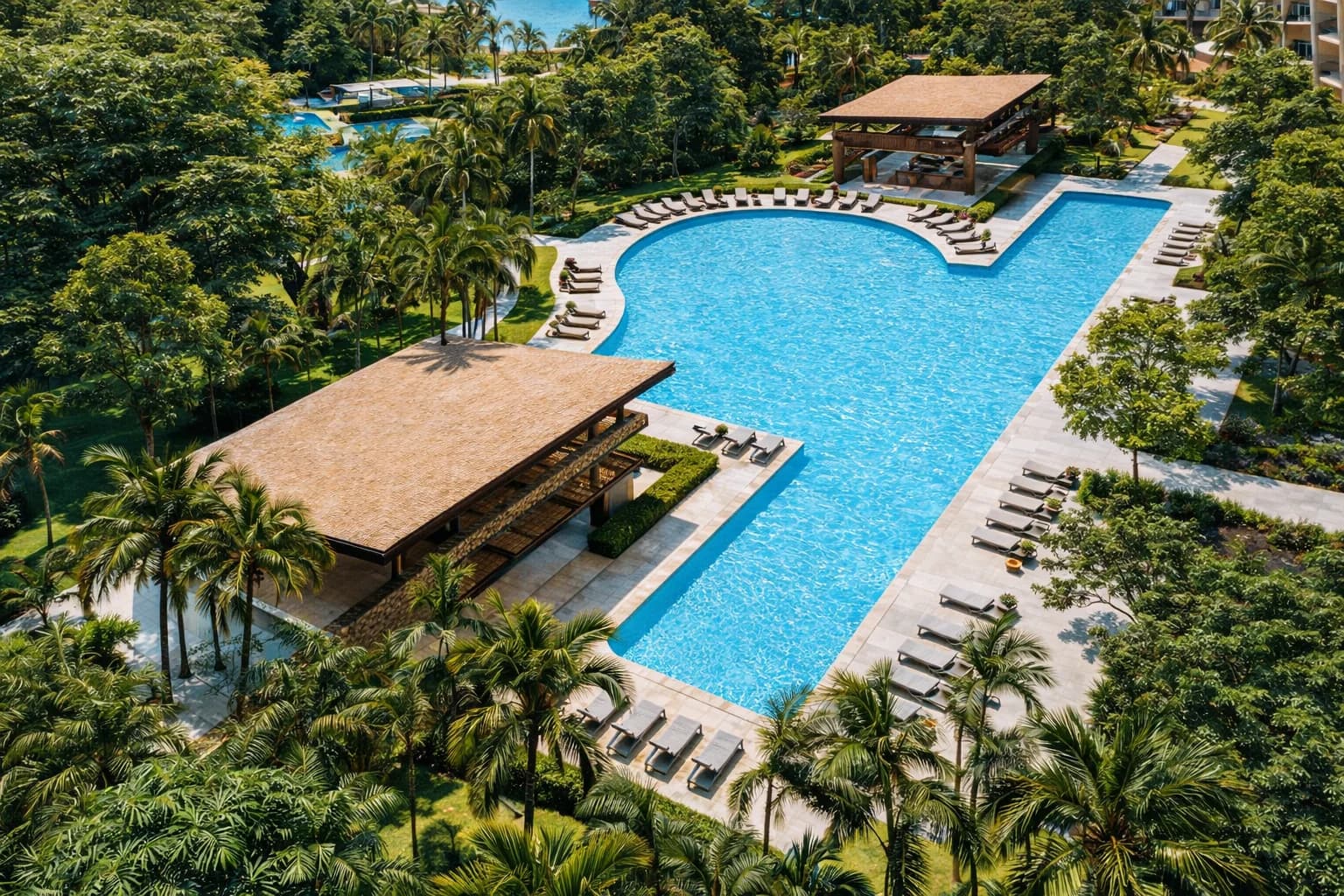
The Guanacaste advantage is driven by high seasonal demand from North American travelers (peak season runs November through April), a growing base of European visitors, and the increasing popularity of the region as a remote-work destination. Properties with ocean views, pool access, and professional management consistently outperform the market average. Browse available residences at Arcadia to see how beachfront positioning affects yield potential in the Brasilito market.
The Tax Advantage: Low Rates Across the Board
Costa Rica's tax environment is one of the most favorable in the world for property owners. The annual property tax rate is just 0.25 percent of the registered property value — one of the lowest in the Western Hemisphere. A $400,000 condo carries an annual property tax bill of approximately $1,000. Compare that to Florida, where effective property tax rates typically run 1 to 2 percent annually, or New York, where they can exceed 2.5 percent.
There is no capital gains tax on the sale of a primary residence for individual owners. Investment properties are subject to a flat 15 percent capital gains rate applied only to the declared net gain, not the gross sale price. Costa Rica also imposes no inheritance tax, making it an attractive jurisdiction for estate planning. The combination of low holding costs and favorable exit taxation significantly improves the net return profile of a Costa Rica real estate investment.
Ownership Structures: Individual vs. SRL
Buyers can hold property either in their personal name or through a Costa Rican SRL (Sociedad de Responsabilidad Limitada), which functions similarly to a US LLC. The SRL structure offers several advantages: it can simplify resale (you sell the company rather than re-recording the deed), provides liability protection, and can facilitate easier transfer of ownership to heirs. Many attorneys recommend the SRL for investment properties, while personal-name ownership is often preferred for primary residences.
Closing costs in Costa Rica typically run between 2 and 4 percent of the purchase price, covering transfer taxes, registry fees, notary fees, and legal fees. Transactions are conducted in US dollars, and escrow is standard practice for all legitimate transactions.
The $150,000 Residency Pathway
An often-overlooked benefit of Costa Rica real estate is the residency opportunity it creates. Foreign nationals who invest a minimum of $150,000 USD qualify to apply for Inversionista residency — providing legal status for the owner and immediate family members, with no requirement to spend a minimum number of days per year in Costa Rica. Residency holders are not subject to Costa Rican income tax on foreign-sourced income and can access the CAJA public healthcare system.
For buyers considering an extended stay or permanent relocation, contact our team at Arcadia to understand how qualifying through a beachfront property purchase can simplify the residency process.
Frequently Asked Questions
Can foreigners own property in Costa Rica?
Yes, foreigners can own Costa Rican real estate with the same fee-simple title rights as citizens. There are no restrictions on foreign ownership, no mandatory local partners, and no percentage caps. All properties are registered in the public Registro Nacional, providing full legal transparency and making title searches straightforward.
What are typical rental yields in Guanacaste?
Well-positioned vacation rental properties in the Guanacaste Gold Coast - particularly in the Flamingo, Brasilito, and Conchal corridor — typically generate gross rental yields of 8 to 15 percent annually. Net yields after management fees (typically 15 to 25 percent of gross) run 6 to 11 percent, which significantly outperforms comparable US coastal markets where 3 to 5 percent gross is the norm.
Is there capital gains tax on Costa Rica real estate?
There is no capital gains tax on the sale of a primary residence for individual owners. Investment properties are subject to a flat 15 percent capital gains tax on the declared net gain only. Annual property tax is just 0.25 percent of the registered value — substantially lower than most North American markets. Costa Rica also has no inheritance tax.
How does the buying process work?
The process involves selecting a property, conducting a title search through the Registro Nacional, signing a purchase-sale agreement, placing funds in escrow, and closing with a Costa Rican notary public. The entire process typically takes 30 to 60 days. Foreign buyers do not need to be present in Costa Rica to close — transactions can be completed through a power of attorney. Closing costs run approximately 2 to 4 percent of the purchase price.